Are you sure you want to mark the task as complete?
Tags
Select the Use button to add a tag to the body of your email. You may also use tags in the subject of your email by copying and pasting them directly in.
Adds the organization email address used as the "From" address for other membership-related emails (e.g., new member welcome emails). Manage email addresses here.
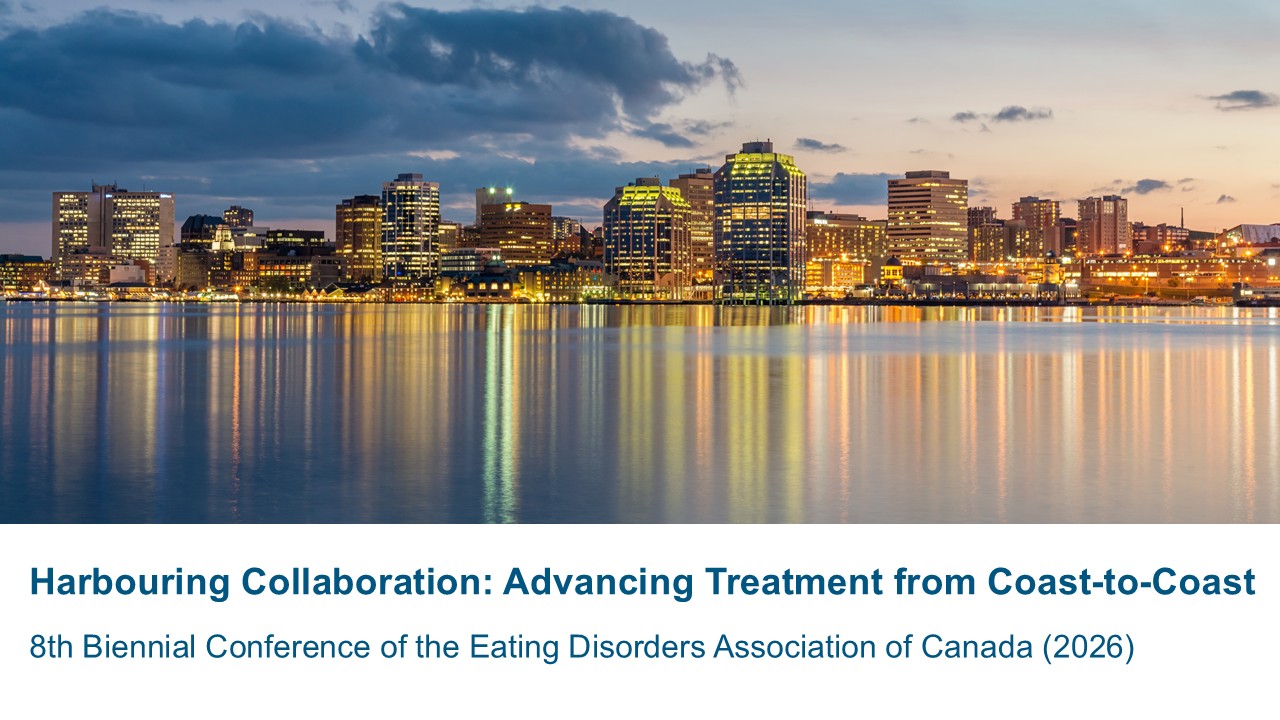
On behalf of the Eating Disorders Association of Canada / Association des Troubles Alimentaires du Canada (EDAC-ATAC), we cordially invite you to attend EDAC/ATAC 2026, the 8th Biennial Meeting. You are welcome to join your EDAC/ATAC colleagues in Halifax, Nova Scotia from April 27-28, 2026, at the Halifax Marriott Harbourfront.
8th Biennial Conference of the Eating Disorders Association of Canada
B1. Collaborating For Change: Tackling Weight Stigma In Treatment
27 avril 2026 13:00 - 14:30 Frais: $0.00 Place Disponible:22
Presenter: Julie Sweeney
Description: Weight stigma remains one of the most significant barriers to effective and compassionate eating disorder care. Despite best intentions, treatment approaches often reinforce harmful biases that prevent individuals from receiving the support they deserve. In this interactive workshop, we will explore the impact of weight stigma on clients, clinicians, and treatment outcomes, and consider how collaborative, weight-inclusive approaches can transform care across the country. Drawing from over 12 years of lived and professional experience in the field, I will share stories, reflections, and practical strategies that highlight both the harm caused by weight stigma and the opportunities for change. Participants will be invited to engage in discussion, reflection, and practice exercises that support awareness, empathy, and action. Together, we will explore how to build treatment environments that are equitable, inclusive, and effective from coast to coast.
B2. Dear Body, Across The Sea: Healing Body Image Through Collaboration
27 avril 2026 13:00 - 14:30 Frais: $0.00 Place Disponible:41
Presenter: Rebecca Carley
Description: In keeping with the conference theme of collaboration, this interactive 90-minute workshop explores how reflective letter-writing can bridge nutritional therapy and counselling in supporting body image healing. Participants will engage in short reflective exercises comparing how they describe a loved one with how they describe themselves, followed by guided writing of a “Dear Body” letter to deepen compassion and awareness. Brief framing introduces how nutritional therapy and counselling each offer complementary perspectives, one supporting physical nourishment and balance, the other fostering emotional safety and reflection. Approximately 15 minutes will be devoted to framing, 60 minutes to experiential and discussion activities, and 15 minutes to integration and closing. Designed to be inclusive and accessible, the session honours diverse body experiences and lived perspectives while exploring shared learning between UK and Canadian practitioners. This reflective workshop is not therapy but offers a safe, contained space for exploration.
B3. Navigating Glucagon-Like Peptide-1 Agonists In Eating Disorder Care
27 avril 2026 13:00 - 14:30 Frais: $0.00 Place Disponible:0
Presenters: Sara Bartel & Aaron Keshen
Description: Glucagon-like peptide-1 agonists (GLP-1As) are increasingly being discussed and researched within the eating disorder field. Due to the nascent and evolving nature of the literature, eating disorder clinicians are often unsure how these medications work and how to effectively discuss these medications with clients. The proposed workshop will provide an overview of GLP-1A medications (10 minutes), outline current research and consensus guidelines on eating disorders and GLP-1As (15 minutes), discuss potential negative impacts of GLP-1As on eating disorder treatment (10 minutes), and provide practical information about speaking with eating disorder clients about GLP-1As (15 minutes). Active learning techniques to be used in workshop include live polling of clinician experience and knowledge (10 minutes) and several breakout discussions (30 minutes). Participants will leave this workshop with a an up to date understanding about GLP-1As and eating disorders, as well as a guide for discussing these medications with clients experiencing eating disorders.
B4. Empowering Recovery “ The Evidence And Experience Behind Peer Support
27 avril 2026 13:00 - 14:30 Frais: $0.00 Place Disponible:46
Presenters: Shaleen Jones & Gina Dimitropoulos
Description: Peer support is recognized as a critical service enhancing engagement across the continuum of care from emergency departments to community-based organizations. Guided by their lived experience, peer supports provide emotional, practical and social support and meet individuals where they are at in their eating disorder journey, decreasing isolation, and enhancing motivation and readiness for change. Peer supporters can play a pivotal role in supporting individual while they wait for specialized services, compliment traditional care and provide system navigation across different sectors.
In this workshop, we will identify the best and emerging practices for delivering peer support for those impacted by eating disorders and in different contexts. Finally, we will learn about the Peer Support model delivered by Eating Disorder Nova Scotia, including their training model and lessons learned on how to deliver effective peer support for those living with eating disorder and their families.
C1. Navigating The Psychedelic Frontier: What Is The Therapeutic Potential Of Psilocybin Treatment For Eating Disorders?
27 avril 2026 15:00 - 16:30 Frais: $0.00 Place Disponible:40
Presenter: Elena Koning
Description: There is emerging transdiagnostic evidence for the therapeutic potential of psychedelic treatments in psychiatry, including preliminary evidence of safety and effectiveness in eating disorders (ED). Several clinical trials are underway investigating psychedelic treatments for EDs, however, the field is challenged by study design limitations and regulatory barriers. Moreover, psychedelics pose unique safety concerns for EDs that are yet to be addressed in conventional psychedelic treatment protocols. To educate clinicians and researchers on this emerging field, this workshop will explore the present and future of psychedelics in ED treatment, focusing on neurobiology, phenomenology, current evidence, and our protocol for the first randomized controlled trial testing psilocybin treatment as an adjunct to cognitive behavioural therapy for bulimia nervosa. This session is designed for clinicians, researchers, and trainees, and incorporates both didactic (45min) and interactive (45min) learning components to cultivate an understanding of the rapidly evolving landscape of psychedelics in ED treatment.
C2. Harbouring Change: MED-DBT And Collaborative Contingency Management For EDs
27 avril 2026 15:00 - 16:30 Frais: $0.00 Place Disponible:4
Presenter: Anita Federici
Description:Collaboration lies at the heart of effective treatment for complex eating disorders (EDs), within teams, across systems of care, and between providers and patients. Drawing from the Multidiagnostic Eating Disorder – Dialectical Behavior Therapy (MED-DBT) model, this interactive workshop explores how collaborative contingency management (CM) can anchor treatment teams and enhance therapeutic outcomes across levels of care.
Contingency management (CM) refers to the systematic application of reinforcement principles to increase desired behaviors and decrease problematic ones by linking specific behaviors to clear, consistent consequences. In practice, this may include reinforcing attendance and skill use, or linking privileges such as phone access or meal passes to treatment engagement. Across levels of care, CM principles are often already embedded, through structured weight contingencies, level systems, or behavioral expectations, but when applied inconsistently or without collaboration, they can create team polarization, patient opposition, and ruptures in trust.
Implementing CM effectively in ED populations can be challenging. Clinicians may feel uncertain about how to set or adjust contingencies, struggle to maintain consistency, or “give in” to intense emotional reactions when holding limits. Patients may perceive contingencies as punitive, and multidisciplinary teams can find it difficult to maintain unified responses across settings. This workshop reframes CM not as behavioral control, but as a collaborative process, a means of fostering coherence, transparency, and shared values across the therapeutic environment.
C3. Building Bridges: How Mentorship Shapes Sustainable Eating Disorder Services In The Maritimes
27 avril 2026 15:00 - 16:30 Frais: $0.00 Place Disponible:61
Description: This workshop shares how Prince Edward Island successfully launched a provincial eating disorder service through partnership and collaboration with Nova Scotia’s Provincial Service and capacity-building approach. We will walk through the journey—from early leadership engagement to implementation—highlighting practical strategies that fostered trust, shared learning, and system-level change. Real-world data, including the number of clinicians trained annually and referrals since 2022, will demonstrate the measurable impact of this partnership. Participants will explore key initiatives developed through collaboration and discuss ongoing efforts to sustain and expand services. Interactive breakout sessions will focus on identifying gaps in current systems, strategies for building partnerships, and actionable steps to implement or enhance services. By the end of the session, attendees will leave with practical tools for initiating service change, engaging stakeholders, and scaling evidence-based care delivery across regions or provinces.
C4. From Program Evaluation To Measurement-Based Care: Insights And Opportunities
27 avril 2026 15:00 - 16:30 Frais: $0.00 Place Disponible:44
Presenters: Elizabeth Quon & Nicole Obeid
Description:Introduce measurement-based care and describe how this differs from traditional program evaluation. Provide overview of the history of program evaluation at CHEO. Discuss how the evaluation needs have shifted with significant expansion of the program. Review the activities our team has undertaken to transform our approach to data collection, including program logic models, current/future-state mapping, input from clinical team and patient representatives, and change management strategy.
Large- and small-group interactive exercises and discussions to 1) reflect on the constructs that are important to measure and evaluate when providing care to people with eating disorders; 2) generate progress indicators to evaluate patient outcomes on a continuous basis in their programs; 3) discuss how data may be used to support clinical care, quality improvement, and research.
Conclude by reviewing the constructs and progress indicators to be used at CHEO and sharing lessons learned from our journey to inform application at other sites.
F5. Suicide Postvention In Eating Disorder Treatment: Clinical Perspectives
27 avril 2026 15:00 - 16:30 Frais: $0.00 Place Disponible:69
Presenters: Sarah Smith & Gina Dimitropoulos
Description: Suicide is the second leading cause of death among individuals with eating disorders. Despite this, many clinicians report having no formal training in suicide postvention. This workshop will focus on current evidence and best practices in suicide postvention with a focus on their relevance to individual clinicians and teams providing eating disorder care in different settings. Specifically, we will summarize common effects of patient suicide on clinicians, explain the concept of postvention, discuss recommended best practices and answer questions based on our experiences as clinicians, and/or clinical team leaders, who have lost patients to suicide at different stages of our careers.
E1. Breaking Barriers: Navigating Fears Of Self-Compassion In Eating Disorders Treatment
28 avril 2026 13:00 - 14:30 Frais: $0.00 Place Disponible:0
Presenters: Josie Geller & Aleece Katan
Description: Individuals with eating disorders often exhibit notably low levels of self-compassion. Despite evidence that self-compassion can be fostered through therapeutic or self-guided approaches, many individuals with eating disorders fear that adopting a compassionate stance toward themselves may reduce their standards or that they are undeserving of compassion. Grounded in empirical research and enriched by the voices of individuals with lived experience, this workshop offers a dynamic exploration of fears of self-compassion within the context of eating disorders treatment. Using interactive case vignettes, patient-recorded videos, and group discussions, participants will gain a deeper understanding of the fears of self-compassion commonly encountered in this population, how these fears present in clinical settings, and will learn evidence-based strategies to address them. Further, participants will be invited to reflect on their own attitudes toward self-compassion and learn strategies to “walk the runway” – an approach to embodying and modeling self-compassion in their clinical work.
E2. Scaling The Implementation Of Family Based Treatment: From A Single Hospital To A Provincial Training Program—Lessons Learned
28 avril 2026 13:00 - 14:30 Frais: $0.00 Place Disponible:55
Presenters: Jessica Wournell & Brynn Kelly
Description: This workshop shares the journey of scaling Family-Based Treatment (FBT) for eating disorders from a single hospital site to a province-wide training program. Beginning with the creation of the IWK FBT Training Clinic, we will outline key milestones: annual training offerings, formation of a provincial interest group, consultation services, and integration of provincial training clinics. Participants will learn how clinician capacity grew through structured training, supported by engagement from interested parties and sustainability planning. Real-world feedback from clinicians and leadership—captured through surveys and vignettes—will illustrate successes and challenges in implementation. Interactive activities will allow participants to apply lessons learned in their own contexts, focusing on strategies for scaling evidence-based treatments. By the end of the session, attendees will understand practical steps for building sustainable training initiatives.
E3. From Patient To Partner: Forming A Research Advisory Board
28 avril 2026 13:00 - 14:30 Frais: $0.00 Place Disponible:56
Presenters: Beth Hales, Laura Lapadat, Sarah Racine, Maureen Plante, Patient Partners
Description:For almost two years, our lab has worked closely with a Research Advisory Board (RAB) consisting of eight patient partners with lived eating disorder (ED) experience across Canada. The RAB has been involved in every step of the research, from initial grant writing to the final project, which aims to develop an evidence-based personalized feedback intervention for those with EDs. We propose a workshop co-created alongside patient partners on how attendees can start their own RAB.
1. A 30-minute didactic presentation covering the importance of and key considerations when conducting participatory research and forming a RAB.
2. A 30-minute panel discussion involving two members of the research team, an Indigenous collaborator, and two patient partners reflecting on their experience being on our RAB.
3. A 30-minute interactive workshop outlining the step-by-step process on how to form a RAB. Conference participants will leave with a RAB implementation plan specific to their future research.
E4. Wait-List Interventions To Support Pediatric Eating Disorders Patients Awaiting Treatment
28 avril 2026 13:00 - 14:30 Frais: $0.00 Place Disponible:5
Presenters: Renee Pang, Lisette Yorke, Joy Abramson
Description: The aim of this workshop is to equip health care providers with tools to support children and adolescents diagnosed eating disorders while awaiting assessment and treatment from tertiary specialized programs and treatment. We will outline components for effective wait-list interventions to mitigate related risks and possibly improve treatment outcomes. Through comprehensive case studies and multidisciplinary feedback, this workshop will provide insight as to how care-providers can address risks associated with the lapse between referral, diagnosis and treatment, while exploring barriers in implementing the interventions and potential solutions.
F1. Neurodivergence And Eating Disorders: Sensory Considerations
28 avril 2026 15:00 - 16:30 Frais: $0.00 Place Disponible:0
Presenter: Krista Blatchford
Description: The connection between neurodivergence and eating disorders is becoming increasingly recognized, particularly the role of sensory processing in shaping eating patterns and food relationships. This 60 minute presentation looks at eating behaviours through a sensory lens, exploring how differences often seen in autism, ADHD, and related neurodivergent profiles can influence food preferences, interoception, and emotional regulation. We’ll discuss how traditional eating disorder treatments may need to be adapted to meet the needs of neurodivergent clients in a way that feels both effective and affirming.
F2. The Value Of A Social Justice Lens In Eating Disorder Treatment: An Integrative Review
28 avril 2026 15:00 - 16:30 Frais: $0.00 Place Disponible:66
Presenter: Sara Kolomejac
Description: Historically and at present, majority of eating disorder research has been focused on
individual rather than systemic/structural level issues. There is a gap in the literature on
integrating an equity-social justice lens in eating disorder treatment. This scoping review aims to
examine existing scholarship using a social justice lens in early intervention eating disorder
treatment in specialized settings. The purpose of the review is to identify scholarly work,
methodological applications, and frameworks using social justice as a critical lens in eating
disorder treatment. As a doctoral student the author will describe their epistemological
positionality as a scientist-researcher in eating disorder treatment. The purpose of this paper is to examine and identify existing gaps in representation and equity and where this lens is largely
absent or scantly included. The paper will conclude with reasons eating disorder practitioners
and researchers should consider taking on eating disorders as a social justice issue.
F3. Mapping Recovery Together: Collaborative Approaches To Eating Disorder Support
28 avril 2026 15:00 - 16:30 Frais: $0.00 Place Disponible:49
Presenters: Corinne Bergstrom & Jennie Mendoza
Description: The Continuum of Recovery is a framework for mapping eating disorder support within any region. Its pillars highlight key areas influencing the recovery journey and, when strengthened by community-centered initiatives, create a solid foundation for long-term recovery.
This interactive workshop explores how understanding the full range of community resources can support earlier intervention and more holistic care. Participants will map their local support landscape to identify key services, intersections, and opportunities for collaboration.
We will introduce Recovery Navigation as a method for guiding clients along their recovery path. Designed to support individuals at any stage, it offers a broad view of available resources, connecting clients with supports that meet their needs while linking them to the wider network of care.
Through case-based learning, attendees will co-create client pathways and leave with a practical, adaptable framework to strengthen collaborative, community-driven recovery support.
F4. Specialized Treatments For People With Long-Standing Eating Disorders: Personalization Or Discrimination?
28 avril 2026 15:00 - 16:30 Frais: $0.00 Place Disponible:8
Presenters: Howard Steiger, Linda Booij, Mimi Israel
Description: Many controversies exist surrounding the implications of duration of illness in the eating disorders (EDs)—with a common belief associating longer illness duration with reduced likelihood of recovery. Recommendations for people with long-standing EDs include prioritizing harm reduction, brief self-admission hospital stays, and care in units designed for people with long-standing EDs. This workshop is led by clinician-scientists from the Douglas Eating Disorders Continuum (EDC) in Montreal. Since 1986, the EDC has been treating people with all variants of EDs, including those that have been long-standing or refractory to previous treatment. Supported by clinical and biological data, presenters will review available evidence of the prognostic implications of long-standing illnesses and evaluate recommendations for its treatment [45 mins]. Workshop leaders will utilize clinical vignettes and experiential learning methods [45 mins] to discuss the clinical implications of illness duration and the potential benefits and limitations of personalized treatments for long-standing EDs.
C5. What We Want You To Know: Insights From Those With Lived Experience
28 avril 2026 15:00 - 16:30 Frais: $0.00 Place Disponible:33
Presenters: Catherine Armour & Shaleen Jones
Description:Less than 1 in 4 people living with an eating disorder seek out or receive treatment, and our current treatments for eating disorder only result in recovery for 30-50% of individuals. Equity-deserving groups, including 2SLGBTQIA+ communities and racialized Canadians experience unique and increased risk and barriers to care.
Insights from those navigating eating disorder recovery are an invaluable resource for removing barriers to care, improving treatment outcomes, and sustaining recovery.
Our panel will share their learnings and perspectives gained as part of their own recovery journey, with a special emphasis on their experience with provincially funded treatment programs. Panelists will speak to what was helpful, what was not, and what changes might have been helpful for them.
Participants will take part in guided discussions on ensuring mutual respect, empathy, safety, and power dismantlement when working to centre lived experience along with addressing common challenges and pitfalls around meaningful engagement.
Privacy Policy
Personal information:
Personal information is collected on this website only when you voluntarily submit it by, for example, registering for the website, or updating your user profile. We respect the privacy of your personal information. Any collected personal information will not be shared, sold, or disclosed to any person or party, and will only be used within to communicate our news, events, and other services with you.
Information collected from your computer or other electronic device:
We may also collect information about your online activities and your computer or other electronic device when you visit this website. This information may include your Internet Protocol (IP) address, domain name, browser type, date and time of your request and information provided by tracking technologies, such as cookies. This information does not identify any individual. We may also use tracking devices to identify websites that you visit before and after this website. This tracking helps us to understand our users better and to improve our website and the information it provides and to maintain and administer the website. This tracking does not involve the collection of personal information.
Access and choice:
Keeping your information accurate and up-to-date is important so we can provide you with helpful information and services. You may update, correct, or delete personal information by modifying your user profile. You can choose not to receive information about specific products and services, or any other promotional materials, from us by e-mail at any time by modifying your communication preferences also located in your user profile.
Links to other websites:
We may provide links to third-party websites. We are not responsible for and cannot control the privacy practices of those other sites. Those sites will have their own privacy policy which may be different from this privacy policy. Please check the privacy policy for each site you visit.
Changes to the privacy policy:
We reserve the right to revise this privacy policy at any time. You will be notified of any significant changes made herein.
Purchase/Refund Policy
All sales are final.
-(fr)Code of Conduct-
Qui peut accéder au portail des membres Eating Disorders Association of Canada (EDAC-ATAC)?
Veuillez noter que le portail des membres Eating Disorders Association of Canada (EDAC-ATAC) doit être utilisé par les membres de Eating Disorders Association of Canada (EDAC-ATAC) uniquement. Certains espaces de travail au sein du portail des membres seront adaptés et limités à certains types de membres; l'accès à ces espaces sera déterminé et approuvé par le personnel de Eating Disorders Association of Canada (EDAC-ATAC). Le contenu affiché dans votre portail de membre variera automatiquement en fonction de votre type d'utilisateur/de membre.
Qu'est-ce qui peut être affiché?
Pour garantir la sécurité et la convivialité de toutes les interactions sur le portail des membres Eating Disorders Association of Canada (EDAC-ATAC), le personnel de Eating Disorders Association of Canada (EDAC-ATAC) supervisera l'activité du portail des membres et examinera, modifiera et supprimera tout contenu inapproprié qui aura été soumis. Cela comprend le langage abusif ou offensant, le polluriel, les fichiers malveillants ou tout autre contact irrespectueux. Afin de favoriser un environnement productif, veuillez signaler toute activité suspecte ou choquante au personnel de Eating Disorders Association of Canada (EDAC-ATAC). Veuillez noter que tout le contenu soumis par les utilisateurs n'est pas représentatif de Eating Disorders Association of Canada (EDAC-ATAC) et ne représente pas nécessairement les opinions de Eating Disorders Association of Canada (EDAC-ATAC), de son personnel ou de ses membres.
Privacy Policy
Personal information:
Personal information is collected on this website only when you voluntarily submit it by, for example, registering for the website, or updating your user profile. We respect the privacy of your personal information. Any collected personal information will not be shared, sold, or disclosed to any person or party, and will only be used within to communicate our news, events, and other services with you.
Information collected from your computer or other electronic device:
We may also collect information about your online activities and your computer or other electronic device when you visit this website. This information may include your Internet Protocol (IP) address, domain name, browser type, date and time of your request and information provided by tracking technologies, such as cookies. This information does not identify any individual. We may also use tracking devices to identify websites that you visit before and after this website. This tracking helps us to understand our users better and to improve our website and the information it provides and to maintain and administer the website. This tracking does not involve the collection of personal information.
Access and choice:
Keeping your information accurate and up-to-date is important so we can provide you with helpful information and services. You may update, correct, or delete personal information by modifying your user profile. You can choose not to receive information about specific products and services, or any other promotional materials, from us by e-mail at any time by modifying your communication preferences also located in your user profile.
Links to other websites:
We may provide links to third-party websites. We are not responsible for and cannot control the privacy practices of those other sites. Those sites will have their own privacy policy which may be different from this privacy policy. Please check the privacy policy for each site you visit.
Changes to the privacy policy:
We reserve the right to revise this privacy policy at any time. You will be notified of any significant changes made herein.